
The Seed
Want to download this song? Return to the Songs page, add this song to your playlist, then open My Playlist. Select the song and choose Download Song to review the Free Use agreement.
Lyrics
Verse 1
It’s been down there for a long time
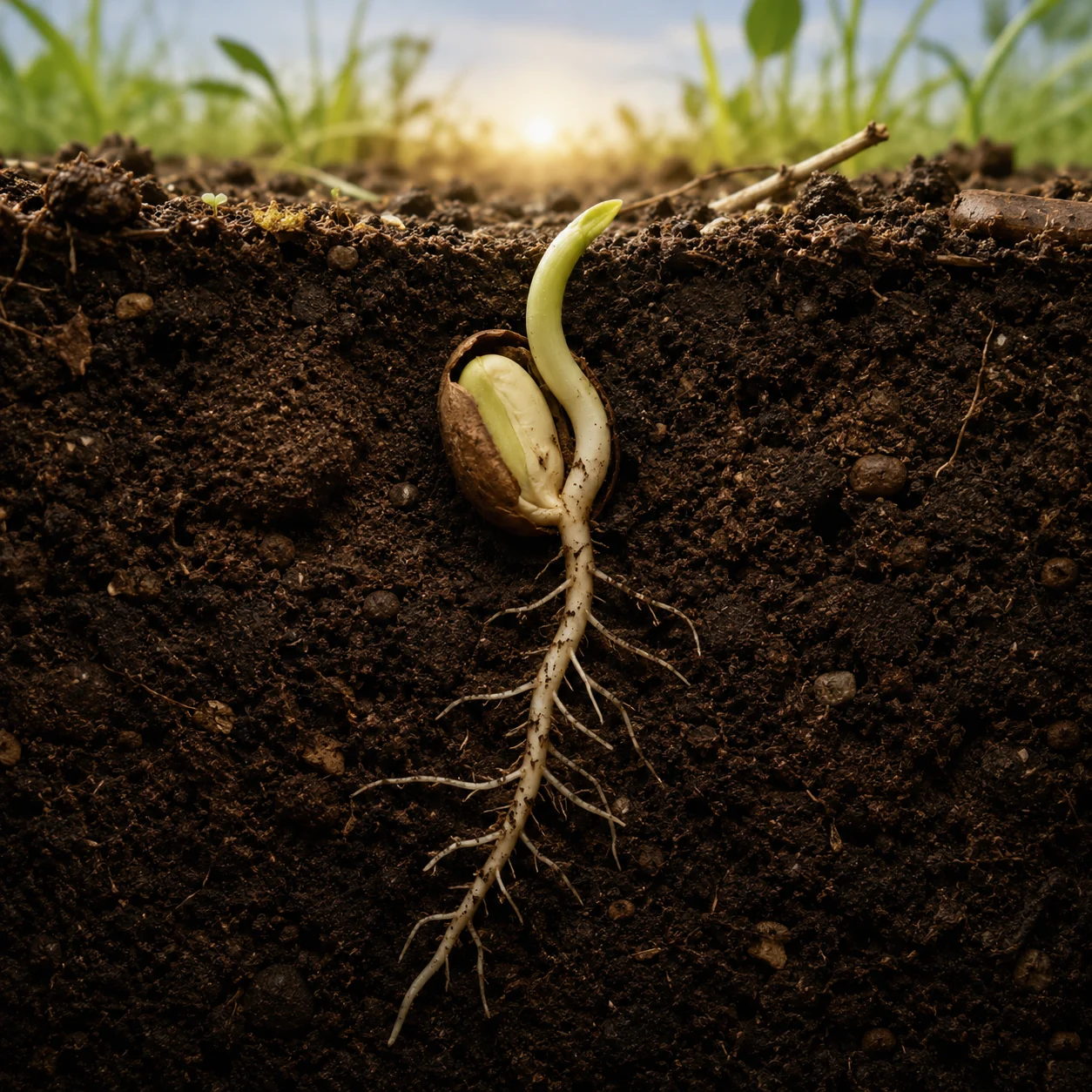
That seed that I found and planted
There’s been plenty of time for it to climb
To the top after the seed coat expanded.
Pre-Chorus
Do I water it some more
Or mulch it with straw
Do I dig and explore
So I can say what I saw?
Chorus
Just because I cannot see
Doesn’t mean it cannot be
Something’s stirring underneath
Doing work beyond my reach
Verse 2
I must trust the seed to know what to do
To know which way’s up and which is down
Soon a sprout cracks and pokes through
As the first leaves unfurl and crown.
Pre-Chorus
Do I water it some more
Or mulch it with straw
Do I dig and explore
So I can say what I saw?
Chorus
Just because I cannot see
Doesn’t mean it cannot be
Something’s stirring underneath
Doing work beyond my reach
Verse 3
What’s radical is that radicle
The primordial root, feeling its way down
It seems as if it’s magical
How it knows the way, deep underground.
Pre-Chorus
Do I water it some more
Or mulch it with straw
Do I dig and explore
So I can say what I saw?
Chorus
Just because I cannot see
Doesn’t mean it cannot be
Something’s stirring underneath
Doing work beyond my reach
Bridge
What if I am like that seed underground
Feeling alone and abandoned in the dark
Can I trust God to help me rebound
And within me, a new life to start?
Final Pre-Chorus
Do I trust God, there in the dark
Or crack open and let myself go
Do I reach for His Light, not the work
And let my new life grow?
Final Chorus
Just because I cannot see
Doesn’t mean I cannot be
Some One’s showing me the way
The way up to the Light of day.
Outro
He will tend me, I can wait
I know I cannot rush my fate
What looks like nothing’s there to me
May be what he's designed me to be.
Devotional
What Grows Beyond Our Reach
Jesus describes the kingdom of God with a man who casts seed into the ground and then sleeps and rises while “the seed should spring and grow up, he knoweth not how” (Mark 4:26–27). The earth “bringeth forth fruit of herself” until the harvest comes (Mark 4:28–29). Jesus is teaching about the kingdom of God, not promising that every personal hope will sprout on our schedule. But His parable establishes a humbling truth: God's work reaches beyond what human hands can see or control.
The song, The Seed, gives that limit a gardener's voice. Its repeated question—“Do I water it some more / Or mulch it with straw / Do I dig and explore / So I can say what I saw?”—captures the unease of having done what we can and still seeing bare ground.
Care Is Real; Control Is Limited
A gardener has responsibilities. Seed must be planted; soil may need water and protection. But digging it up every day to check its progress can destroy the very growth the gardener hopes to see.
Paul makes a related distinction when he says, “I have planted, Apollos watered; but God gave the increase” (1 Corinthians 3:6). He continues, “neither is he that planteth any thing, neither he that watereth; but God that giveth the increase” (1 Corinthians 3:7). Paul is speaking about ministry, not gardening advice or a guaranteed result for every effort. Still, the order matters: our work is real, and growth remains God's to give.
That frees us to ask a more faithful question than, “How can I make this happen?” We can ask, “What has God given me to do today?” Sometimes the answer is to tend carefully. Sometimes it is to leave the soil undisturbed.
Hidden Does Not Mean Absent
The first movement of a germinating seed is often downward. A root develops where the gardener cannot see it, supporting a shoot that has not yet appeared. The song's radicle is a precise image of hidden beginnings.
We should be careful when carrying that image into our lives. We cannot look at every long wait and declare that God must be producing the particular outcome we want beneath it. Scripture does not give us that knowledge. But it does tell us that the limits of our sight are not the limits of God's presence. The psalmist asks, “Whither shall I go from thy spirit? or whither shall I flee from thy presence?” (Psalm 139:7), and even in darkness he says, “the darkness hideth not from thee” (Psalm 139:12).
We may be unable to see what comes next without being unseen by Him. Faith does not require us to call bare soil a sprout. It allows us to tell the truth about what we see while trusting the God who sees more.
Waiting Has Work of Its Own
James uses the farmer's patience to call believers to steadfastness: “Behold, the husbandman waiteth for the precious fruit of the earth, and hath long patience for it” (James 5:7). Then he says, “Be ye also patient; stablish your hearts” (James 5:8). The farmer cannot rush the season, but patience is not indifference. It is a way of remaining faithful through time.
When the bridge of the song, The Seed, turns from a planted seed to a person “Feeling alone and abandoned in the dark,” the metaphor becomes a prayer. It asks whether we can trust God there. That question need not be answered with forced certainty about when relief will come. We can bring Him our fear, keep doing the work that belongs to us, and ask for the strength to wait without tearing open what we cannot yet understand.
The final pre-chorus turns toward His light rather than obsessive inspection of the work. That does not diminish the work. It puts it in its proper place. Our attention returns to God, whose care does not depend on our ability to monitor every sign of progress.
Hope Has a Firmer Ground Than a Sprout
A visible sprout would be welcome. It is not the foundation of Christian hope. Peter blesses God who “hath begotten us again unto a lively hope by the resurrection of Jesus Christ from the dead” and speaks of an inheritance “reserved in heaven for you” (1 Peter 1:3–4). Our hope rests first in what God has done in Christ, not in our ability to predict what will happen in one difficult season.
Paul likewise writes, “hope that is seen is not hope”, and then, “if we hope for that we see not, then do we with patience wait for it” (Romans 8:24–25). In context, that hope reaches far beyond the success of a single undertaking or the end of one period of waiting.
This matters when the ground stays bare longer than we expected. We need not invent evidence of growth to keep trusting God. Nor does waiting mean we are abandoned. Our firmest assurance rests in Christ and His promise rather than in our prediction of how this season will turn out.
The song's closing image leaves the seed in the care of its tender: “He will tend me, I can wait.” We can receive that image as an invitation: tend what has been entrusted to us, refrain from claiming knowledge we do not have, and place ourselves in God's hands. He sees us even here.
For Reflection
What am I responsible to tend today? What am I tempted to dig up because I cannot bear not knowing? Have I made a particular outcome the measure of whether God is present with me? Can I faithfully care for what He has entrusted to me while leaving the increase in His hands?
Prayer
Father, You see what I cannot. Show me the work You have given me today, and give me the patience to do it faithfully. Keep me from neglecting what needs care or trying to control what belongs to You.
When I feel alone in the dark, remind me that I am not hidden from You. Help me speak honestly about my fear without surrendering my hope. Set my trust in Jesus Christ, whose resurrection gives me a firmer hope than any result I can see. Teach me to wait with open hands and to receive each sign of life with gratitude. Amen.
Extra Info — Scripture Map
The seed growing beyond the sower’s knowledge: Mark 4:26–29
Human planting and watering; God’s increase: 1 Corinthians 3:5–9
No darkness hides us from God: Psalm 139:7–12
The farmer’s patience and steadfast waiting: James 5:7–8
Living hope grounded in Christ’s resurrection: 1 Peter 1:3–5
Patient hope for what is not yet seen: Romans 8:24–25