
Pruned
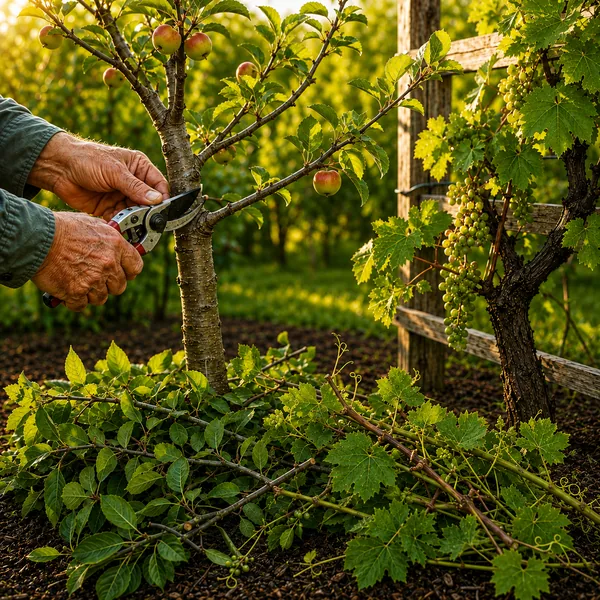
Want to download this song? Return to the Songs page, add this song to your playlist, then open My Playlist. Select the song and choose Download Song to review the Free Use agreement.
Lyrics
Verse 1
There stands a tree that's bearing fruit,
But something doesn't look quite right.
Its branches bow beneath the load,
Bent low under the growing weight.
It grew so tall, it grew so fast,
Reaching upward toward the sky—
But now the fruit those branches bear
Is pulling all that growth awry.
Chorus
Father, prune me the way You know,
Make cuts that are best for me,
Shape the way that I should grow,
Make me what You designed me to be.
Verse 2
Its last prune missed the point
How you cut a branch informs
How it grows beyond that joint
And potentially how it performs.
It reached for height instead of strength,
With little branching there inside,
And fruit grew heavy on its length,
Till all that weight pulled it awry.
Chorus
Father, prune me the way You know,
Make cuts that are best for me,
Shape the way that I should grow,
Make me what You designed me to be.
Verse 3
One branch could bend no more,
The weight was more than it could bear,
It broke beneath the fruit it bore,
Its broken length hanging there.
The damage could not be undone,
A sharp cut had to clean the wound,
What could be saved was left upon
The tree; the rest lay on the ground.
Bridge
What if I’m that bending branch,
Bearing more than my years?
Would I trust the Gardener’s hand
When I see Him with the shears?
Final Chorus
Father, prune me the way You know,
Make cuts that are best for me,
Shape the way that I should grow,
Make me what You designed me to be.
If some good fruit must fall away,
Help me trust what You can see—
You know the weight that I can bear,
Lord, tend Your growing tree.
7-Day Devotional Study
Day 1 — The Fruitful Branch
Jesus says, “I am the true vine, and my Father is the husbandman”, and then adds that “every branch that beareth fruit, he purgeth it, that it may bring forth more fruit” (John 15:1–2). There is something almost unsettling in those words. The branch being pruned is bearing fruit. It isn’t dead or barren. It is doing exactly what we expect a healthy branch to do. And the Husbandman cuts it.
We understand removing dead, diseased, or damaged growth. But why touch something alive and fruitful? The apple tree described in the song, Pruned, helps me understand. A branch can produce good fruit and still be developing in a way that cannot sustain it. The gardener sees more than the apples. He sees the strength and structure of the branch carrying them, and what it will need as it continues to grow. The branch knows only that something good is growing from it.
We can make the same mistake. We may assume that because something in our lives is fruitful, God intends it to continue exactly as it is. A ministry, responsibility, relationship, talent, or season may be producing something genuinely good. And still, the Gardener may prune. That doesn’t mean the fruit was bad. It may mean He knows what the branch will eventually be asked to bear.
Jesus also tells us who holds the shears: “my Father is the husbandman.” The branch does not decide how another branch should be pruned, nor does it hold the shears over itself. The Father does.
Perhaps the first lesson of pruning, then, isn’t about cutting at all. It is about trusting the One who holds the shears.
Reflection: Is there something fruitful in my life that I assume must remain simply because it is good? Can I trust God to decide not only what should grow, but how, when, and for how long?
Prayer: Father, thank You for every good thing You have allowed to grow in my life. Keep me from confusing fruitfulness with believing the tree belongs to me. When I cannot understand what You are shaping, remind me that You see what I cannot see. Father, prune me the way that You know is best for me.
If you haven’t already, please listen to the song, Pruned.
Day 2 — Pruning Is Personal
The psalmist says, “O LORD, thou hast searched me, and known me” and “art acquainted with all my ways” (Psalm 139:1, 3). The apple trees behind the observations in the song, Pruned, don’t all need the same pruning. One may need crowded branches thinned. Another may need damaged growth removed. Another may need its shape corrected while the branches are still young. Even trees growing beside one another, in the same soil and under the same sun, can need very different care.
That is what makes pruning personal. A good gardener doesn’t simply walk from tree to tree making the same cuts. He studies each tree—how it has grown, where it is strong, where it is weak, what happened in previous seasons, and what its present structure can support.
People can sometimes see enough of our lives to recognize that something needs attention. But even someone with good intentions can mistake the visible problem for the real one. The apple tree described in the song, Pruned, had been pruned and looked better afterward, yet the underlying weakness in its structure remained. Pruning itself is not evidence of good husbandry. Knowing what to prune matters.
God does not have to guess. The One who holds the shears is already acquainted with all our ways. He knows our history, our strengths and weaknesses, our maturity, our present burdens, and what He is preparing us to carry. But He knows something even more personal: He knows how He designed us to grow. A skilled gardener understands the natural growth habit of the tree in his care and works with it toward the shape and purpose he intends. God knows our nature because He designed it. The Master Gardener doesn’t merely see what is growing. He knows the architecture of the whole tree—and the design from which it was meant to grow.
That also means we should be careful about picking up the shears for one another. We can encourage, teach, counsel, and help each other—but another person’s life is not ours to prune according to our own judgment. The Father knows what this particular tree needs.
Reflection: Have I ever compared God’s work in my life with what He seems to be doing in someone else’s? Am I willing to trust that the Gardener knows why my pruning may look different from theirs?
Prayer: Father, You know me more completely than anyone else ever could. You know how You designed me to grow and what You intend me to become. Keep me from measuring Your work in my life by what You are doing in another. Help me trust Your hand as You shape my growth according to Your plan. Father, prune me the way You know.
If you haven’t already, please listen to the song, Pruned.
Day 3 — The Architecture Within
Paul says, “But now are they many members, yet but one body” and “Now ye are the body of Christ, and members in particular” (1 Corinthians 12:20, 27). So far, we have looked at the apple tree described in the song, Pruned, as a picture of one believer—a single life personally known, shaped, and tended by the Gardener. But now, step back from the tree for a moment. Instead of seeing one life, look at all its branches together. The picture changes.
Each branch has its own place on the tree. It grows where it has been formed to grow, develops its own smaller branches and leaves, and bears fruit along its own structure. Each branch bears its fruit, and when all the branches do their part, the tree as a whole benefits.
Paul describes the Body of Christ in much the same way. We are “many members, yet but one body.” Each believer is an individual, with particular gifts, responsibilities, opportunities, and fruit. Yet none of us is the whole tree. God has placed us together so that what happens in one part contributes to the life of the whole.
The apple tree described in the song, Pruned, also shows us why the architecture within matters. Healthy branching doesn’t merely provide more places for fruit to grow. As the tree develops its branching structure, growth and fruit are distributed throughout the tree rather than being concentrated on a few long, poorly structured shoots. The leaves throughout that branching system manufacture the food that supports continued growth—not only of those branches, but of the larger limbs, trunk, and roots to which they are connected. The branches contribute to the tree that supports the branches.
That is a beautiful picture of Christian community. We don’t merely turn to other believers when the weight becomes too heavy and ask them to hold us up. We grow together long before that happens. We teach and are taught. We encourage and are encouraged. We serve and are served. We pray for others and are carried by their prayers. As each member grows and bears fruit, the Body itself becomes stronger.
Galatians tells us, “Bear ye one another’s burdens, and so fulfil the law of Christ” (Galatians 6:2). Sometimes another branch will indeed need help carrying its weight. But that help comes from relationships that have already been allowed to branch. Perhaps there is a warning here, too. A branch can reach impressively high all by itself. It can even bear good fruit. But height and fruitfulness alone do not tell us whether healthy architecture is developing underneath them.
God has not designed us merely to grow upward toward Him. He has also placed us where we can grow outward toward one another.
Reflection: Am I trying to grow as a solitary branch, or am I allowing my life to become genuinely connected with the Body of Christ? What fruit has God given me to bear in my particular place—and how might that fruit strengthen the whole?
Prayer: Father, thank You for giving me my own place within Your Body. Teach me to bear faithfully the fruit You have given me without believing I must bear it all. Help me grow toward You and toward the people You have placed around me. Use my growth to strengthen the whole, even as I receive strength through others. Father, prune me the way You know.
If you haven’t already, please listen to your voice choice of the song, Pruned.
Day 4 — When the Branch Can Bear No More
Scripture tells us, “Bear ye one another’s burdens, and so fulfil the law of Christ” (Galatians 6:2). One of the branches on the apple tree described in the song, Pruned, finally stopped bending. It broke.
The fruit hanging from it was good fruit. There was nothing wrong with the apples. But the branch had grown long without developing enough branching structure for the load it eventually carried. As the apples grew heavier, the branch bent lower and lower until the weight became more than it could bear.
There is an important difference between bearing fruit and bearing weight. We often celebrate the first without noticing the second. Something in our lives may be good, useful, productive, even God-honoring—and still become heavy to carry.
Sometimes we assume that if God has allowed good fruit to grow on our branch, we must be responsible for carrying all of it ourselves. We keep adding one good thing to another: one person who needs us, one responsibility, one opportunity to serve, one task worth doing. None of them looks like something that should be discarded. The difficulty is that good things still have weight.
That is one reason the architecture we considered yesterday matters. God did not design us to carry every burden alone. Scripture tells us plainly to “bear ye one another’s burdens.” There are times when the answer to a bending branch isn’t immediately to remove its fruit, but to let another member of the Body help carry the weight.
But the apple tree described in the song, Pruned, gives us a harder lesson as well. Sometimes the branch has already reached the limit of what its present structure can sustain. At that point, preserving everything on it may no longer be possible. The gardener may have to choose the health of the tree over keeping every piece of fruit. That can be difficult to accept because we tend to ask, “Is this good?” The Gardener may be asking a different question: “Can this branch carry it?”
The bridge of the song, Pruned, asks:
What if I’m that bending branch,
Bearing more than my years?
Would I trust the Gardener’s hand
When I see Him with the shears?
Perhaps maturity includes learning that faithfulness is not measured by how much weight we can accumulate before we break. There is no virtue in proving that we can carry everything. Sometimes trust means allowing God to show us what belongs on our branch now, what can be shared with another, and what may need to be released—even when it is good.
Reflection: Are there good things in my life that have become heavier than I can responsibly carry? Have I confused faithfulness with carrying everything myself? Is there a burden I should allow someone else to help me bear—or something good I need to trust the Gardener enough to release?
Prayer: Father, You know the weight of every piece of fruit on my branch, and You know the strength of the branch carrying it. Keep me from measuring faithfulness by how much I can hold. Teach me to receive help when a burden should be shared and to release even something good when You know I should no longer carry it. When I feel myself bending, help me trust the One who sees both the fruit and the branch. Father, prune me the way You know.
If you haven’t already, please listen to the song, Pruned.
Day 5 — The Cut
Hebrews says God's chastening is “for our profit, that we might be partakers of his holiness”. Though “for the present” it does not seem joyous but grievous, “nevertheless afterward it yieldeth the peaceable fruit of righteousness” (Hebrews 12:10–11). Knowing that a tree needs pruning is only the beginning. The gardener must also know where to make the cut.
A pruning cut is not simply the removal of unwanted wood. Where the cut is made—and what kind of cut is chosen—affects how the tree responds afterward. Some cuts encourage new shoots near the cut. Others remove a branch at its point of origin. Still others shorten a limb by taking it back to another branch capable of becoming its new growing direction. A skilled gardener is thinking not only about what disappears today, but about what the tree is likely to do next.
That changes how we think about pruning. When God removes or changes something in our lives, we naturally focus on what is gone. We see the cut. We feel the absence. We may even understand eventually why something needed to change. But the Master Gardener sees beyond the place where we are looking. He knows what He is shaping beyond the cut.
The apple tree described in the song, Pruned, also teaches us that a cut can be necessary because of damage already done. When that fruit-laden branch finally broke, the broken portion could not simply be put back where it had been. The damaged wood had to be removed with a proper cut so the remaining tree could respond as a tree is designed to respond.
Trees do something remarkable after injury. They do not heal a wound in quite the way our bodies do. Instead, they compartmentalize the damaged area and continue growing around it. The wound becomes part of the tree’s history, but it does not have to become the end of its growth.
There is something worth considering there.
We sometimes ask God to restore our lives by making them exactly as they were before something painful happened. But His work in us does not always look like erasing the evidence that anything happened. Sometimes He leads us into healthy new growth with the scar still part of our story.
Hebrews tells us that God’s correction is “for our profit” and that what is grievous in the present can afterward yield “the peaceable fruit of righteousness.” The pain itself is not called good. The cutting is not described as pleasant. The attention is directed toward what comes afterward.
That may be one of the hardest things about trusting the Gardener. We are standing at the cut, looking at what has just been removed.
He is tending what remains.
And because He knows the architecture of the tree, He knows where new growth can safely begin.
Reflection: Is there a place in my life where I am still looking primarily at what was cut away? Have I been asking God only to restore what was there before, rather than allowing Him to shape what grows next? Can I trust Him with both the wound and the growth around it?
Prayer: Father, when Your work in my life leaves an empty or tender place, help me trust what I cannot yet see beyond it. I may remember the wound even after new growth begins, but do not let me mistake a scar for the end of my story. Shape what remains, direct what grows next, and use even painful correction to produce the fruit You desire. Father, prune me the way You know.
If you haven’t already, please listen to the song, Pruned.
Day 6 — Nothing Is Wasted
Paul writes, “And we know that all things work together for good to them that love God, to them who are the called according to his purpose” (Romans 8:28). After that branch broke on the apple tree described in the song, Pruned, something bothered me.
There were good apples on it.
They had grown exactly as apples were supposed to grow. They weren’t diseased or spoiled. Yet when the damaged branch had to be cut away, perfectly good fruit came down with it.
It is easier to understand pruning when we picture God removing something harmful. But what happens when the thing that falls is good?
We have already considered that good fruit still has weight, and sometimes a branch simply cannot continue carrying everything growing upon it. But releasing the fruit raises another question:
What happens to the good that was removed?
In an orchard, fruit that falls from a branch does not necessarily become useless. An apple no longer hanging on the tree may become food for a deer, a raccoon, an insect, or another creature passing beneath it. Eventually, what remains can return to the soil and become part of the continuing life around the tree.
Its usefulness did not depend upon remaining attached to that particular branch.
Perhaps we sometimes make that mistake with the good things in our own lives. We believe that if something has been entrusted to us, then we must be the ones to carry it all the way to its intended purpose. If God removes it from our hands, we may wonder whether the time, love, effort, teaching, creating, serving, or sacrifice invested in it has somehow been wasted.
But something leaving my hands does not mean it has left God’s hands.
Romans 8:28 does not tell us that everything that happens is good. Nor does it promise that we will always be shown what became of something we had to release. It tells us that God is able to work “all things together for good” according to His purpose.
That means I do not have to know where every fallen apple goes.
Something I began may be completed by someone else. Something I taught may bear fruit years after I have forgotten saying it. A responsibility I can no longer carry may become another person’s opportunity to serve. Even something that appears to have ended may nourish a life I will never see. And sometimes, perhaps, I will never know what God did with it at all.
The branch doesn’t have to keep the fruit for the fruit to have purpose.
That frees the branch from one more burden: believing that everything good God has ever allowed it to carry must remain there forever.
The Gardener tends more than one branch. He tends the whole garden.
Reflection: Is there something good I have had to release that I still think of as wasted? Have I been measuring its value by whether it remained in my hands? Can I trust God with the usefulness of something even after I can no longer see what becomes of it?
Prayer: Father, thank You for every good thing You have allowed me to carry. When the time comes to release something, keep me from believing that its value depended upon my keeping it. I may never see what You do with what leaves my hands, but I can trust that it has not left Yours. Teach me to hold Your gifts faithfully without believing I must hold them forever. Father, prune me the way You know.
If you haven’t already, please listen to the song, Pruned, one more time.
Day 7 — Lord, Tend Your Growing Tree
Paul writes, “Being confident of this very thing, that he which hath begun a good work in you will perform it until the day of Jesus Christ” (Philippians 1:6). For six days we have been looking closely at a tree.
We have looked at its fruit and its branches. We have considered how differently each tree may need to be pruned, how its inner architecture develops, how good fruit can become more weight than a branch can bear, what happens at the place of the cut, and how even something released from our branch need not be wasted.
But perhaps we have been looking at something else all along. A life being tended by God. At the beginning of this study, the prayer in the song, Pruned, may have sounded simple:
Father, prune me the way You know,
Make cuts that are best for me,
Shape the way that I should grow,
Make me what You designed me to be.
After this week, those words may not feel quite so simple.
To ask God to prune us is to give Him authority over things we may value. It is to acknowledge that fruitfulness does not always mean something should remain unchanged. It is to trust that He knows our individual design, that He understands the strength of our branches, and that He sees the architecture developing within us.
It is also to accept that we were never meant to grow alone.
We are branches within something larger than ourselves, giving and receiving strength within the Body of Christ. There may be seasons when others help us carry what has become too heavy. There may also be times when the Gardener knows that something—even something good—must leave our branch.
And sometimes there will be a scar where the cut was made. But the scar is not the whole tree. Neither is the missing branch. Neither is the fruit lying on the ground. The tree is still growing.
Paul’s confidence was not in his own ability to finish what God had begun in him. His confidence was in the One doing the work: “he which hath begun a good work in you will perform it.”
Perhaps that is where this week has been leading us. Not toward becoming experts at identifying everything God should remove from our lives. Not toward picking up the shears ourselves. Not even toward understanding every cut. But toward knowing the Gardener well enough to place the tree in His hands.
The final chorus of the song, Pruned, asks something harder than it did when we began:
If some good fruit must fall away,
Help me trust what You can see—
You know the weight that I can bear,
Lord, tend Your growing tree.
That may be the prayer beneath every lesson of this week.
Lord, tend Your growing tree.
Reflection: As I look back over these seven days, where did I recognize myself most clearly—in the fruitful branch, the differently tended tree, the branch needing stronger connections, the limb bending beneath good fruit, the place of the cut, or the fruit that had to be released? Can I trust the Gardener even when I do not understand what He is doing next?
Prayer: Father, this life is Yours. You know how You designed me, what You have called me to bear, what I can carry, what I need from others, what must remain, and what must be released. Keep me from reaching for the shears when they belong in Your hands. Give me grace to trust You in the growing, the bending, the cutting, and the growing again. I do not need to understand every cut to know the Gardener. Lord, tend Your growing tree.
If you haven’t already, please listen to the song, Pruned, once more.
Let me ask you this one question:
Do you trust the Gardener? ☐ Yes ☐ No ☐ I would like to inspect the shears first ☐ Can I see the pruning plan?
Extra Info — Dig Deeper
Scripture & Botanical Reference
This reference expands the biblical and botanical background behind the seven-day study. The grapevine carries the direct pruning image used by Jesus in John 15; the apple tree carries the lived observation that gave rise to Pruned. They are not botanically interchangeable, so each is allowed to contribute what is actually true of it.
The plants help us understand the illustration. Scripture determines the spiritual truth. The botanical notes are offered to deepen the picture, not to turn every horticultural fact into a spiritual claim.
Vine versus Tree
Reference note: The seven-day devotional remains the spiritual study. This section is a supporting reference for readers who want to examine the Scripture map and the horticultural background in greater depth.
The Bible references the vine as well as the tree that needs pruning. Each needs different care, and that includes pruning. For each of the days, we go into how the specific theme of the day relates to both the Vine and the Tree… and possibly where they overlap.
Day 1 - The Fruitful Branch
Primary Scripture: John 15:1-2
Related passages: John 15:4-5; Galatians 5:22-23; Hebrews 12:10-11
The Vine
Jesus begins with a vine, and grapevine pruning makes the image especially concrete. Grapevines are pruned every dormant season because the buds retained on selected one-year-old wood will produce shoots and clusters in the coming season. Pruning therefore does not mean the retained wood was barren or worthless. The pruner deliberately removes much living wood in order to maintain vine structure, canopy architecture, and a crop level the vine can support.
The Tree
Apple trees also require pruning while they are healthy and productive. Proper pruning develops and maintains a strong framework, improves light penetration, supports fruiting wood, and can reduce limb breakage. A branch can therefore be alive, productive, and still be part of a tree that needs further shaping.
What They Show Together
Fruitfulness and pruning are not opposites. Both grapevine and apple-tree practice show that productive woody plants are tended with future growth and future fruit in view.
Day 2 - Pruning Is Personal
Primary Scripture: Psalm 139:1-3
Related passages: Psalm 139:13-16; Ephesians 2:10; 1 Corinthians 12:18
The Vine
There is no single pruning formula for every grapevine. Decisions vary with cultivar, vine vigor, health, bud condition, site, climate, production goals, and training system. Cane-pruned and spur-pruned vines retain different kinds and amounts of one-year-old wood. Even within one vineyard, the number of buds retained may be adjusted to vine size and performance.
The Tree
Tree pruning is equally dependent on the individual plant. Age, species or cultivar, natural growth habit, existing structure, previous pruning, damage, and purpose all influence what a skilled pruner should do. Young apple trees are often trained to establish permanent scaffold structure; mature bearing trees are managed differently.
What They Show Together
Good pruning begins with knowing the plant in front of you. The same tool can be used wisely or poorly depending on whether the pruner understands the plant, its condition, and the desired structure.
Day 3 - The Architecture Within
Primary Scripture: 1 Corinthians 12:20, 27
Related passages: 1 Corinthians 12:14-26; Romans 12:4-5; Galatians 6:2
The Vine
A grapevine is trained into an organized structure: roots, trunk, cordons or canes, spurs or retained fruiting positions, and then the seasonal shoots that carry leaves and clusters. Trellis and training systems position those parts so light, air, growth, and fruit can be managed through the whole vine rather than concentrated in a tangled canopy.
The Tree
Apple trees are likewise trained into a framework. In a central-leader system, a trunk supports tiers of scaffold limbs, which in turn support smaller branches and fruiting wood. Well-spaced scaffold limbs with favorable angles distribute the canopy and crop while allowing light into the tree.
What They Show Together
The architecture is not decoration around the fruit. It is part of what makes sustained fruitfulness possible. The branches and shoots carry the crop, while their leaves contribute photosynthate to the larger plant that supports them.
Day 4 - When the Branch Can Bear No More
Primary Scripture: Galatians 6:2
Related passages: 1 Corinthians 12:25-26; Ecclesiastes 4:9-10; Romans 12:15
The Vine
Viticulture distinguishes between simply having many clusters and maintaining vine balance. Dormant pruning, shoot thinning, and sometimes later cluster thinning are used to balance vegetative growth with fruit biomass. A highly fruitful vine can carry more crop than is desirable for its vigor and canopy.
The Tree
Fruit has weight, and leverage matters. Heavy crops can bend or break fruit-tree limbs, particularly when fruit is concentrated toward the ends of long branches or when branch structure is weak. Training, branch angles, pruning, and fruit thinning are all used to reduce structural failure.
What They Show Together
Good fruit can still become too much load for the structure carrying it. The botanical issue is not whether the fruit is good, but whether growth, structure, and crop are in balance.
Day 5 - The Cut
Primary Scripture: Hebrews 12:10-11
Related passages: Proverbs 3:11-12; James 1:2-4; Psalm 119:71
The Vine
In grapevines, the consequences of a cut are immediate and practical because pruning selects the buds and fruiting wood that remain for the next season. In cane pruning, removing the wrong cane can remove an entire intended fruiting section. In spur pruning, retained spurs must be positioned to fit the training system and future shoot growth.
The Tree
Trees respond differently to different cuts. Thinning or branch-removal cuts remove a branch at its point of attachment; heading cuts shorten a branch and often stimulate vigorous shoot growth below the cut. Proper branch-removal cuts preserve the branch collar and work with the tree's natural defenses. Trees do not restore wounded wood as animal tissue does; they compartmentalize injury, forming internal barriers and new wound-wood around the damaged area.
What They Show Together
A pruning cut does more than remove what was there. It changes what remains and influences what happens next. The exact biology differs between vine and tree, but in both, knowledgeable cutting is future-oriented.
Day 6 - Nothing Is Wasted
Primary Scripture: Romans 8:28
Related passages: Genesis 50:20; 1 Corinthians 3:6-7; John 12:24
The Vine
Grape clusters removed during crop thinning are no longer part of that season's harvest, but removal can contribute to the larger goal of vine balance, fruit quality, and sustainable growth. The value of the management decision is therefore not measured only by how much fruit remains attached.
The Tree
Sound apples that fall or come down with a removed limb can still be eaten by people or wildlife, used for processing, composted where appropriate, or enter nutrient cycling as organic matter decomposes. Orchard sanitation still matters: diseased, infested, or rotting fruit and pruning debris may need to be removed rather than left beneath the tree.
What They Show Together
The careful botanical point is not that every removed fruit should be left where it falls. It is that separation from the original branch does not automatically make something biologically useless. The devotional uses that narrower truth and leaves the larger outcome in God's hands.
Day 7 - Lord, Tend Your Growing Tree
Primary Scripture: Philippians 1:6
Related passages: John 15:1-5; Psalm 1:1-3; Ephesians 2:10; 1 Corinthians 3:6-7
The Vine
A grapevine is trained over years, then pruned and managed every season. Permanent structures are established gradually, while fruiting wood and seasonal shoots are continually renewed. The pruner observes vigor, crop, damage, and vine response and adjusts future decisions accordingly.
The Tree
A fruit tree is also shaped over time. Young-tree training establishes structure; mature-tree pruning responds to light, crowding, fruiting wood, damage, vigor, and risk. One cut never tells the whole story of the tree. The tree keeps growing, and the gardener keeps tending.
What They Show Together
Pruning is an episode within a longer relationship of observation, response, growth, fruiting, and care. That is why the study ends not with mastery of the shears, but with trust in the Gardener.
Botanical Sources & Further Reading
The botanical notes above draw primarily on university Cooperative Extension materials. These sources are written for growers, gardeners, arborists, and vineyard managers and provide the horticultural basis for the pruning, training, crop-load, branch-structure, and wound-response statements used in this reference.
• Penn State Extension - Dormant Cane and Spur Pruning in Bunch Grape Vineyards
• Penn State Extension - A Stepwise Guide to Dormant Pruning and Training Young Grapevines
• Penn State Extension - Early Season Grapevine Canopy Management: Shoot Thinning
• Penn State Extension - Grapevine Cane and Spur Pruning Fundamentals
• Iowa State University Extension - Pruning Apple Trees
• Iowa State University Extension - How to Prune and Train Young Apple Trees
• University of Maryland Extension - Pruning Trees in the Home Landscape
• Penn State Extension - Understanding the Spread of Decay in Trees